How to Size Off-Grid Solar & Battery Storage: Wh, Ah & Inverter Idle Math
The most common rookie mistake in off-grid camper electrical systems is calculating battery capacity based on simple nameplate wattage, only to wake up at 4:00 AM with flat batteries and a shut-off refrigerator.
Real-world battery drain isn't just about what your appliances draw while active; it includes inverter quiescent (idle) load, DC-to-AC conversion heat dissipation (typically 12–15% loss), and winter temperature derating. This guide explains how to estimate battery capacity and solar needs, including a reserve or backup charging plan for cloudy weather.
1. The Real Daily Watt-Hour (Wh) Formula
Never size your system in Amp-Hours (Ah) unless you specify voltage. A 100Ah 12V battery holds 1,200Wh, while a 100Ah 48V battery holds 4,800Wh. Always use Watt-Hours (Wh) for unified sizing:
For a typical overlanding vehicle running a 12V dual-zone fridge (35W @ 30% duty cycle = 250Wh/day), Starlink Mini (35W for 6h = 210Wh), CPAP machine (40W for 8h = 320Wh), laptop/phones (180Wh), and a 12V diesel air heater (25W for 10h = 250Wh), your baseline direct load is approximately 1,210 Wh per day.
This simplified estimate assumes DC loads are measured at the battery and that the inverter efficiency figure excludes the separately counted idle draw. If not, adjust to avoid double-counting; include DC converter losses where applicable. For illustration, assume the fridge and heater use 12V DC (500 Wh combined), while the other devices use AC (710 Wh combined). With 85% inverter efficiency and a 15W inverter left on for 24 hours, estimated battery draw is 500 + (710 ÷ 0.85) + (15 × 24), or approximately 1,695 Wh per day. Actual draw depends on how each device is connected, inverter behavior, temperature, and duty cycle.
For more on how inverter efficiency, load, and temperature affect runtime, see EcoFlow's runtime guidance.
2. Estimating Runtime for a 2,000Wh Battery
In the example above, a 2,000Wh battery divided by 1,695Wh per day provides at most about 1.18 days on nominal capacity, before any battery reserve or temperature-related reductions. Usable capacity and actual runtime vary, so allow a margin and size for the number of days you need without charging.
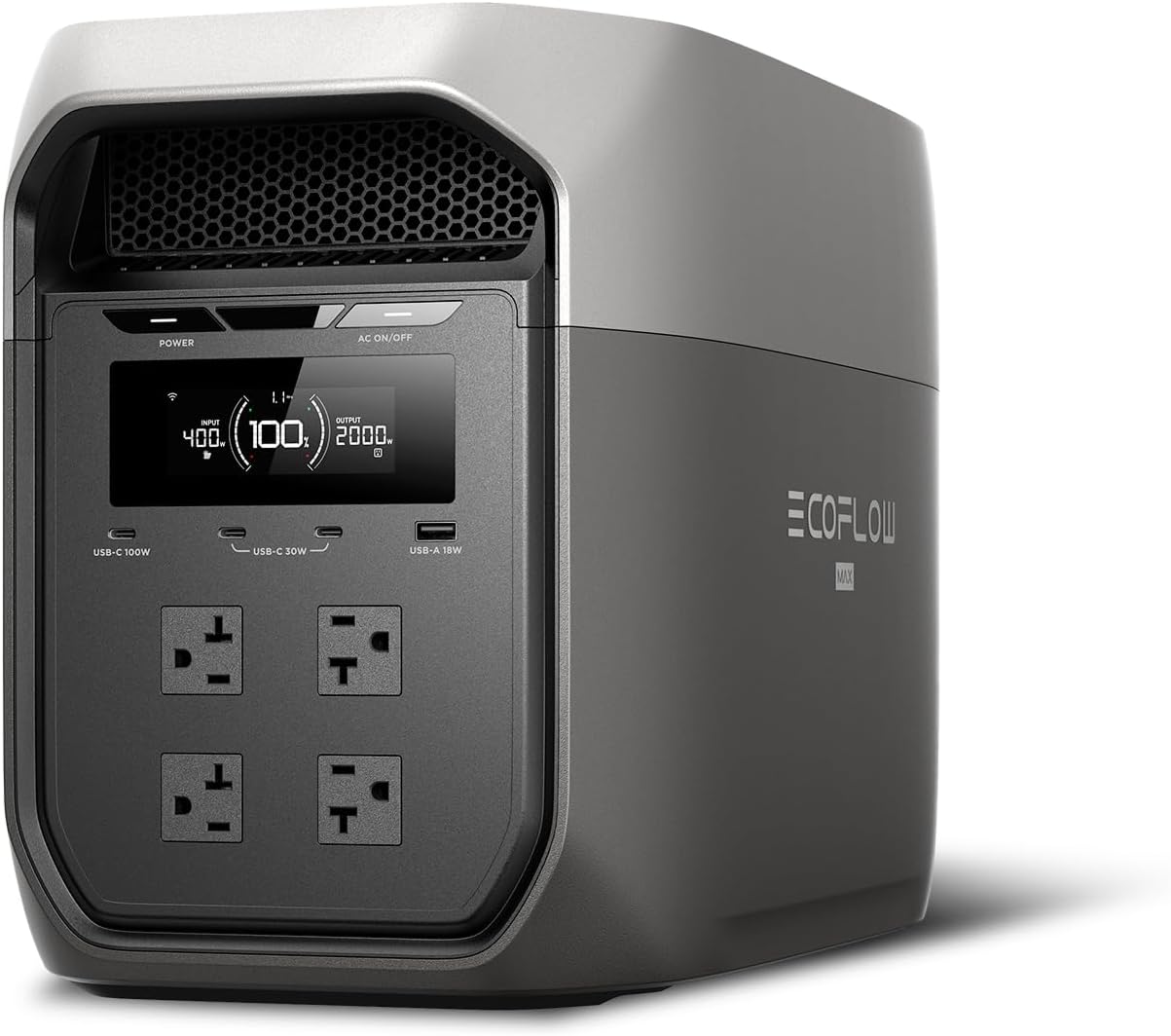
EcoFlow DELTA 3 Max (2048Wh LFP)
A 2,048Wh portable power station to consider when comparing capacity and output. Check the product specifications and current price before buying.
3. Solar Panel Sizing: Peak Sun Hours vs Nameplate Watts
A 200W solar panel does not generate 200W for 10 hours. Peak sun hours vary by location, season, panel orientation, shade, and weather. Use a location-specific winter estimate; the following calculation uses 3 peak sun hours only as an illustration.
For the example's approximately 1,695 Wh per day, assuming 3 peak sun hours and 75% solar system efficiency for charging and wiring losses (separate from the AC inverter losses already included above), the estimate is (1695 ÷ 3.0) ÷ 0.75 ≈ 753 watts of panels. Actual winter sun and system losses vary by location and weather; check the power station's solar input voltage, current, and wattage limits before choosing panels, and plan another charging option for poor weather.